From the blog
HoneyFil® Gummies vs Capsules: Honest Format Guide [2026]
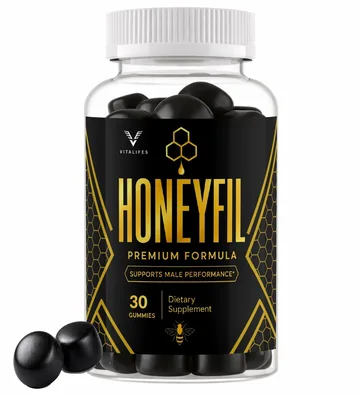
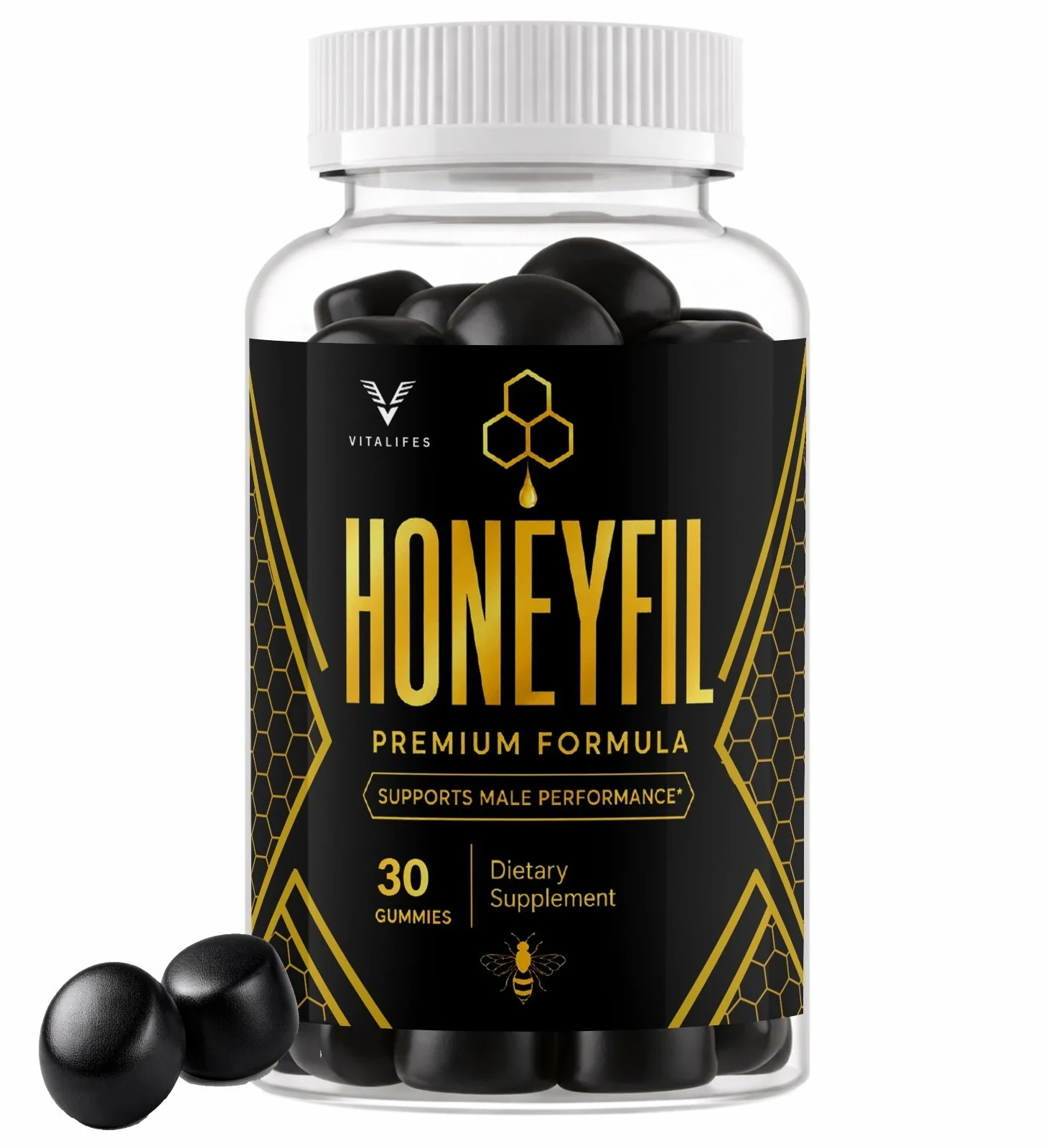
HoneyFil gummies are chewable dietary supplement gummies, taken one a day, with 30 gummies to a bottle. Each gummy prints 20 calories and 3 g of total sugars, and holds vitamin D3 at 84 mcg and boron at 7 mg, with four botanicals at 100 mcg each. That small space is the cost of the gummy format: far less room for active ingredients than a capsule. In exchange, a pleasant chewable is easy to keep taking.
What is physically inside a gummy
Start with the thing nobody puts in the marketing: a gummy is a confection. Before it is a supplement it has to be a sweet that holds its shape, survives a warehouse and tastes acceptable.
That job takes most of its weight. A typical supplement gummy weighs three to four grams, and the great majority of that is a sugar or sugar-alcohol base, a gelling agent (gelatin or pectin), water, an acid for tartness, a colour and a flavour. The active ingredients are what fits in the space left over.
A capsule has the opposite problem: it is a shell around powder, and almost all of its volume is available. A size 0 capsule holds roughly 500 milligrams of powder; a size 00 holds around 750. That is the whole reason a capsule product can carry 500 mg of an extract and a gummy usually cannot.
| Typical gummy | Typical capsule | |
|---|---|---|
| Unit weight | 3–4 g | 0.5–1 g |
| Of which active | Often under 1% | Often 80% or more |
| Room for a 500 mg extract | Very limited | Straightforward |
| Sugar | 2–4 g per gummy | None |
| Shelf stability | Poorer; heat and humidity matter | Good |
| Dose consistency between units | More variable | More consistent |
| Cost per unit of active | Higher | Lower |
The sugar, counted honestly
The HoneyFil panel prints 20 calories, 4 grams of total carbohydrate and 3 grams of total sugars per gummy, with added sugars listed as 0.
Three grams is about three quarters of a teaspoon. Taken once a day for a month that is roughly 90 grams of sugar, or about 600 calories over the bottle. In the context of an ordinary diet this is small, and anyone telling you a daily gummy will derail your health is overstating it.
It is not nothing either, particularly for someone managing blood sugar, and it is a real difference from a capsule, which contains none. If you take three or four different gummy supplements — which is now common — the arithmetic starts to matter.
Why gummies degrade faster
Gummies contain water, and that changes everything about how they age. Active ingredients degrade faster in the presence of moisture, some vitamins react with the sugars and acids around them, and the whole unit is sensitive to temperature.
This is why gummy labels always carry a storage instruction and capsule labels often do not. It is also why gummies arrive fused into a block after a week in a hot mailbox, and why some manufacturers deliberately overfill them so that the amount at the end of shelf life still meets the label.
The practical version is short: bring the box inside promptly, keep them cool and dry as this label says, and check the best-before date. The pictured bottle shows 07-2028.
What the format is genuinely good at
Having listed the costs, here is the case for gummies, which is stronger than supplement snobbery allows.
People take them. Adherence is the thing that decides whether any supplement does anything, and a pleasant chewable gets taken on days a capsule does not. For a vitamin somebody actually needs, that is not a small advantage.
Some people cannot swallow capsules. Difficulty swallowing pills is common, and it is a genuine barrier rather than a preference.
For vitamins, the format fits. Vitamin D at 84 micrograms, B12 at 2.4 micrograms, folate at 400 micrograms: these are microgram-scale ingredients that fit comfortably in the small space a gummy has. A vitamin D gummy is a sensible product.
And what it is bad at
The mismatch appears when the ingredient needs a large dose. Herbal extracts are the clearest case: fenugreek at 500 mg, maca at a gram or more, curcumin at several hundred milligrams. Those amounts simply do not fit in a confection alongside the sugar and the gelling agent.
Faced with that, a manufacturer has two options. Make the gummy much larger and sweeter, or put the herb in at an amount that fits. The second is cheaper and more common, and it is why so many herbal gummies carry botanicals in micrograms.
HoneyFil is a clear example. Its vitamin D is at a serious 84 mcg, because vitamins fit. Its four botanicals are at 100 micrograms each, because they do not. That is not an accusation of dishonesty — the amounts are printed plainly on the panel — it is a description of what the format allows.
That sliver on the left is the bar. Four extracts at 100 micrograms each come to four tenths of one milligram — less than the weight of a grain of table salt.
See what one HoneyFil gummy actually contains.
Check today’s priceHow to choose between the two
Look at what the ingredient needs
Micrograms of a vitamin: a gummy is fine. Hundreds of milligrams of an extract: a capsule or a powder.
Check the botanical units on any herbal gummy
If the herbs are quoted in micrograms, you are buying a sweet with a nice ingredient list.
Count the sugar across everything you take
Three grams once is trivial; three gummy products daily is not.
Be honest about whether you will take the capsules
A gummy you take beats a capsule you forget, and that is not a small point.
Check the storage line and the date
Gummies are the format where both actually matter.
One more thing the format hides
There is a quieter consequence of putting a supplement in a sweet, and it is about consistency rather than quantity.
A capsule is filled by weight from a blended powder, and every capsule in the batch gets the same fill. A gummy is a deposited liquid that sets, and the active ingredients have to survive being heated, mixed, poured and cooled. Heat-sensitive ingredients degrade during that process, so manufacturers often overage the batch — adding more than the label states so that the amount at the end of shelf life still meets it.
That is normal practice and not a scandal. It does mean that a gummy is inherently a less precise delivery format than a capsule, which matters more for something you are dosing carefully than for a vitamin you simply want to top up.
It is also one more reason to read the storage line. An overage is calculated for a product kept cool and dry; it is not calculated for a bottle that spent August in a car.
The bottom line
A gummy is a confection with a supplement in it, and most of its weight goes on being a confection. That makes it an excellent vehicle for vitamins measured in micrograms and a poor one for herbal extracts measured in hundreds of milligrams.
On this product the split is visible on the panel: the vitamin D is at a real dose and the four botanicals are at a tenth of a milligram each. If you want the format, buy it for the vitamin D and take the herbs as decoration. If you want the herbs at doses anyone has studied, you want capsules (U.S. Food and Drug Administration, “Dietary Supplements: What You Need to Know”).
Sources
- U.S. Food and Drug Administration. Dietary Supplements: What You Need to Know. FDA, current revision. Checked September 24, 2026.
- NIH Office of Dietary Supplements. Vitamin D: Fact Sheet for Health Professionals. NIH ODS, current revision. Checked September 24, 2026.
Questions on this topic
More answers on the full FAQ page.
Are gummies less effective than capsules?
Not inherently. They hold far less active ingredient, which matters for herbal extracts and not for microgram-scale vitamins.
How much sugar is in a supplement gummy?
Usually 2–4 g each. This one prints 3 g of total sugars and 20 calories.
Why do gummies melt?
They contain water and sugar, so heat and humidity soften them. Store them cool and dry.
Should I take a gummy or a capsule?
Whichever you will actually take, unless the ingredient needs a large dose — then a capsule.
Ready to try HoneyFil?
Pick a pack and see the price at checkout. The money-back guarantee is 60 days from purchase, unless the sales page prints a longer window. Questions first? Contact the order desk.
Sold through a USA Authorized HoneyFil Retailer. This site is not the manufacturer and earns when you buy.Keep reading
What 100 mcg of a herb means
The difference between micrograms and milligrams, what a 10:1 extract is, why tiny botanic…
Read more →420% of the vitamin D Daily Value
What 84 micrograms of vitamin D3 means in IU, how close it sits to the adult upper limit, …
Read more →HoneyFil ingredients
All seven, with the amounts printed on the panel.
Read more →